
Hydraulic Home Elevator
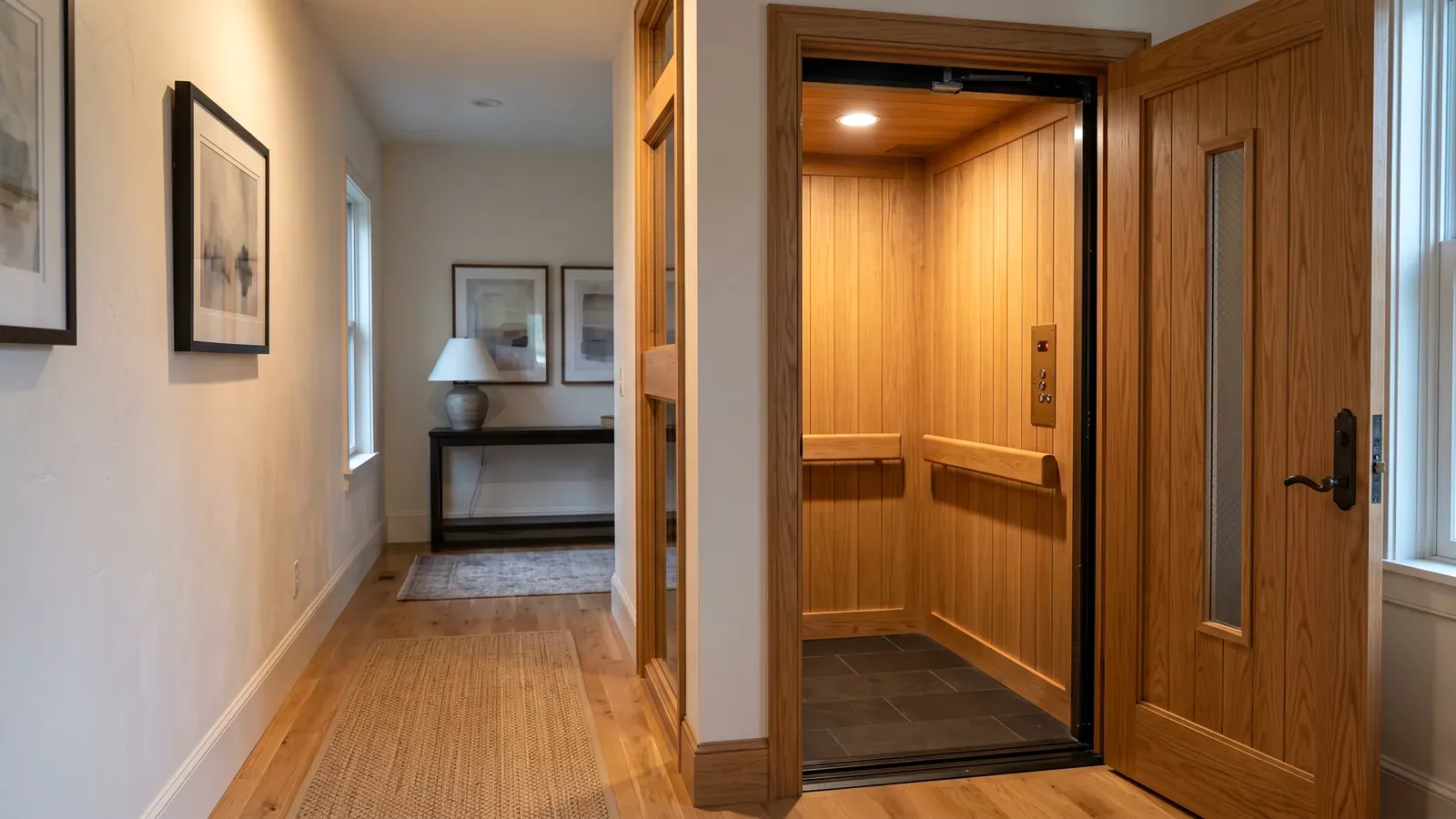
A hydraulic home elevator runs in its own shaft and is pushed up by a fluid-driven piston; a traction or cable elevator does the same job with a motor and cables.
- Installed price
- $25,000–$56,500
- Shaft or pit
- Built shaft and a small pit
- Floor space
- 50 to 56 in across
- Carries
- 500 to 1,400 lb
- Takes a wheelchair
- Some models
Traction or cable elevator
- Installed price
- $27,000–$50,000
- Shaft or pit
- Built shaft and a shallow pit
- Takes a wheelchair
- Some models
Hydraulic and Traction Models and Prices
| Brand | Model | Price | What the price covers | Carries | Floors or travel |
|---|---|---|---|---|---|
 | Elite Plus Residential Elevator | $23,995 | Lift only (list price) | 1,000 lb | 40 ft of travel |
| Victorian Elevator | $18,999 | Lift only (list price) | 950 lb | 40 ft of travel |
 | Elevette and other models | $25,000–$35,000 | Installed (cost guides) | Not stated | Up to 6 floors |
 | Freedom Green | $20,000–$30,000 | Installed (manufacturer's range) | 1,000 lb | 6 floors |
 | Typical two floor project | $35,000–$45,000 | Installed (manufacturer's range) | 500 lb | 2 floors |
Prices as each source states them: a list price is for the equipment only; dealer quotes and ranges include installation. Sources: AmeriGlide, AmeriGlide, Inclinator, Nationwide Lifts, Cambridge Elevating.
Expect to pay $25,000 to $56,500 installed for a hydraulic home elevator. That figure comes from seven published price ranges. The cab travels inside its own shaft, and a piston powered by fluid lifts it from below.
The published numbers don't match one another, so plan for a wide spread. HomeGuide gives $30,000 to $60,000, Angi gives $25,000 to $50,000, and Fixr lands at $22,000 to $53,000. Per Nationwide Lifts, the smallest hydraulic lifts begin at $20,000.
- A traction elevator, put in: $27,000 to $50,000
- Going past two floors tacks on: $9,000 to $15,000 per level
- Putting a shaft into a house that's already built runs an extra: $5,000 to $25,000
Traction Home Elevator
Instead of a piston, this kind of elevator relies on a motor and cables to move the cab. Across 13 published ranges, installed prices usually land between $27,000 and $50,000.
The drive type drives the price. In a winding drum setup, a cable wraps around a drum and pulls the cab up. A counterweight design hangs a weight to balance the cab, and a gearless design skips the gearbox between motor and cables.
| How the traction elevator is driven | What it costs, installed |
|---|---|
| Winding drum with a cable | $28,000 to $50,000 |
| Geared, using a counterweight | $30,000 to $60,000 |
| Gearless, using a counterweight | $50,000 to $75,000 |
HomeGuide is the source for these numbers. Angi and Fixr both come in lower for some models, at $15,000 to $35,000. One Colorado home services company quotes $45,000 to $90,000 in the Boulder and Denver market, which shows how much local pricing can vary.
Plan on replacing the cables every three to five years if you choose a cable-driven model. Angi puts that job at $2,000 to $3,000.
Yearly Upkeep
Angi lists these yearly maintenance costs:
- Hydraulic models: $400 to $1,000
- Traction models: $300 to $900
- Winding drum models: $300 to $600
Compare With Other Kinds of Lift
- Shaftless home elevator
$20,000–$35,000 installed · no shaft
- Small one person lift
$25,000–$30,000 installed · no shaft
- Through floor lift
$30,000–$60,000 installed · ceiling opening
- Pneumatic vacuum elevator
$35,000–$60,000 installed · no shaft
- Outdoor elevator
$18,000–$40,000 · fixed to an outside wall or deck
- Hillside lift
about $60,000 · a car on a rail down a slope
Room and Electrical Requirements
Nearly every model covered here has a cab interior near 36 by 48 inches. The shaft should measure roughly 50 to 55 inches across, with a pit 6 to 12 inches deep. Plan for 92 to 96 inches of headroom.
| Model | Drive | Pit | Capacity |
|---|---|---|---|
 Cibes Symmetry Hydraulic | Fluid piston | 6 in | 1,000 lb |
| Inclinator Elevette Hydraulic 1000 | Fluid piston | 10 in | 1,000 lb |
| Inclinator Elevette Cable Drum 500 | Drum and cable | 6 in | 500 lb |
| Nationwide Lifts Freedom Green WD | Wound-cable type | 6 in | 1,000 lb |
 Savaria Eclipse | Fluid piston or cable, per the listing | 8 in | 950 lb |
Most run on 230 volt single phase power at 20 or 30 amps, and they also need a separate 120 volt circuit for the lights. The Savaria Infinity can run on 208 volt three phase power as well.
Shaft and Drive Changes
Adding a shaft to a house that already stands costs $5,000 to $25,000, per Willow. Switching the drive from cable to hydraulic tacks another $5,000 to $10,000 onto the bill, per Fixr.
Once you include the shaft and machinery, a hydraulic setup comes to $40,000 at minimum, and a version needing a machine room starts at $60,000, again per Fixr.
Alternative Lifts
- A home elevator with no shaft: $20,000 to $35,000
- A lift sized for a single rider: $25,000 to $30,000
- A lift that rises through the floor: $30,000 to $60,000
- A pneumatic vacuum design: $35,000 to $60,000
Common Questions
Hydraulic or Electric: Which Elevator Should You Choose?
Because the two price ranges overlap, cost alone won't settle it. Hydraulic upkeep runs a bit higher each year, $400 to $1,000, compared with $300 to $900 for traction. On top of that, cable-driven models need fresh cables every three to five years.
Will Medicare Cover a Home Elevator?
The sources we rely on don't cover this, so we can't confirm it. Check with your plan directly instead of assuming you're covered.
What Are the Disadvantages of Traction Elevators?
The costs climb fast. Gearless counterweight versions sit at the top of the range, $50,000 to $75,000, while cable-driven ones carry a $2,000 to $3,000 bill for fresh cables every three to five years.
What Does a Third Floor Add to the Total?
Budget an extra $9,000 to $15,000 for every level past the second.
Running Costs and Help Paying
- Yearly service
- $300–$760
- Power
- About $0.10 a day
- Repairs to set aside
- $500–$1,500 a year
Sources: Angi (service), RetirementLiving (power, about 1 kWh a day), Willow (repairs, a Colorado estimate). A repair visit is billed at $75 to $100 an hour (HomeAdvisor).
- VA Specially Adapted Housing grant
Up to $126,526 (FY 2026) for veterans with a qualifying service-connected disability.
- USDA Section 504 repair loan or grant
A loan up to $40,000, or a grant up to $10,000 at age 62 or older, for very-low-income homeowners in rural areas.
- Medical expense tax deduction
The part of the cost that does not raise your home's value can count as a medical expense.
Talk to a Lift Installer Near You
One call gets you a local home elevator dealer who can measure your house and put a written price on it.